Germany's Green Energy Sector Creates 50,000 Environmental Jobs
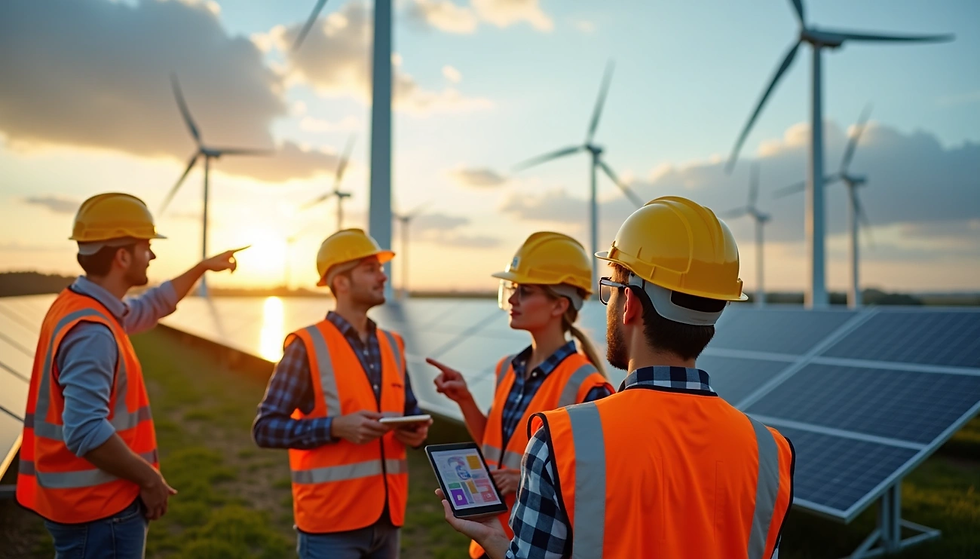
Germany's environmental job market is booming, driven by the country's ambitious energy transition goals. The 'Energiewende' initiative has transformed the nation's power supply, with renewable sources now generating more than half of Germany's electricity. This revolutionary change has positioned renewable energy at the core of the country's economic strategy and created remarkable career opportunities for qualified professionals, including environmental engineers and sustainability officers.
The numbers tell a compelling story. German industries will need 400,000 new workers by 2025 to meet their climate objectives. The German Chamber of Commerce and Industry (DIHK) highlights an even more significant challenge - a projected shortfall of 560,000 workers across 250 vital professions that drive the energy transition. The renewable energy sector alone - encompassing solar, wind, and hydrogen - will require 300,000 skilled professionals over the next decade. The timing is perfect for professionals who want to learn about green jobs or environmental engineering positions in Germany. English-speaking environmental roles have become more accessible as the country works toward its 2045 climate neutrality target. International academics will find these prospects particularly appealing - 66 percent of students and alumni secure jobs during or right after completing their studies. The retention rate remains strong, with just three percent returning to their home countries post-graduation.
Contents
Germany Creates 50,000 Green Jobs Amid Energy Transition
Germany's renewable energy sector created 50,400 new jobs in 2022, signaling a green jobs boom. This is a big deal as it means that employment grew by 14.9% compared to the previous year [1]. The numbers haven't been this high since 2012, and we haven't seen such a big yearly jump since 2006 [1]. Right now, 387,700 people work in renewable energy [1], making green jobs one of Germany's fastest-growing sectors.
What sectors are driving the job boom?
The renewable energy job market in Germany spreads across different areas. Biomass takes the lead with 30% of total jobs (117,900 workers) [1]. Wind energy on land makes up 24% (94,100 employees), and solar energy follows with 22% (84,100 workers) [1]. On top of that, heat from the environment and geothermal energy make up 14% (55,000 employees), thanks to more heat pumps being installed [1]. Offshore wind energy employs 8% (30,100 workers) [1].
Solar energy showed remarkable growth by adding 22,800 new jobs in 2022 [1]. Heat pump installation and geothermal energy created 20,100 new positions as more people needed green heating options [1]. The wind energy sector on land lost about 9,000 jobs [1].
How the Energiewende policy fuels employment
Germany's energy transition policy (Energiewende) creates jobs throughout the country. Most people work in installing renewable energy systems and making components. This accounts for nearly two-thirds of the renewable workforce (238,000 people) [1]. The number grew by 23% from last year [1].
People working in operation and maintenance have steady jobs, with 85,200 positions across all technologies [1]. These roles grow slowly but surely, unlike installation jobs that go up and down with the market [1]. The biogenic fuels industry employs about 65,500 people [1].
Which regions are seeing the most growth?
Green engineering jobs vary across German regions. Hamburg leads the pack with 23.7% of its workforce in green jobs. Saxony-Anhalt has the smallest share at 15.8% [2]. Germany's average of 19.9% green jobs beats the OECD average of 17.6% [2].
Environmental science jobs cluster around research hubs. Seven German regions out of 16 added more green jobs between 2011 and 2021 [2]. Green jobs grew 9.7% faster than other jobs from 2019 to 2022 [2]. Saarland showed the biggest jump with 30.2% growth [2].
What Types of Environmental Jobs Are Being Created?
German environmental sectors provide many career paths for skilled workers. The country's steadfast dedication to environmentally responsible practices has created specialized roles that need technical expertise and fresh ideas. These roles span across various fields including civil engineering, mechanical engineering, chemical engineering, and process engineering.
Environmental engineering jobs Germany: Key roles
Environmental engineers in Germany earn around 53.000 € each year [3]. These experts work between science, technology, and society. They focus on essential areas such as disposal processes, renewable energies, noise protection, water bodies protection, and air pollution control [3]. The medical, pharmaceutical, and consulting sectors pay the highest salaries [3]. Environmental engineers make up the largest group in green protection industries [3]. Their work ranges from pollution assessment to developing sustainable technologies [3]. Many environmental engineers also work on reducing greenhouse gas emissions and implementing climate technologies.
Renewable energy project managers and technicians
Project managers in renewable energy handle engineering services for wind, solar, hydro, biomass, and waste-to-energy technologies [4]. They monitor budgets, manage operations, develop technical proposals, and implement projects [4]. English fluency is essential for most positions. Additional languages like French or Spanish give candidates an edge [4]. Companies now look for experts with deep experience—usually 10+ years in renewable energy consultancy [5]. Strong project management skills are crucial for success in these roles.
Environmental science jobs Germany: Research and analysis
Research institutions like UFZ need environmental scientists [6]. Scientists can work in agricultural resource efficiency, metabolic interaction studies, and hydrometric research [6]. German employers value diversity and equal opportunity. They welcome applications from people with severe disabilities [6]. Academic institutions have several environmental science roles from LCA (Life Cycle Assessment) specialists to sustainability project managers [7]. These roles often require a strong background in scientific methods and analytical skills.
Green logistics and sustainable construction roles
Sustainable construction brings excellent career prospects through programs like DGNB certification [8]. Experts in this field help create eco-friendly environments through architecture, engineering, urban planning, and real estate [8]. Green logistics roles support material flow for eco-conscious production. This includes receiving, storing, and shipping components under safety guidelines [9]. These positions need experience with hazardous materials, knowledge of ADR regulations, and strong English communication skills [9]. Many of these roles focus on developing energy efficient buildings and climate-friendly homes.
What Skills Do Freshers Need to Enter the Green Job Market?
Getting into Germany's growing environmental sector takes specific skills. In fact, employers look for "T-shaped professionals" who combine deep technical knowledge with broad soft skills [10].
Technical skills in energy systems and engineering
German environmental engineering jobs need strong foundations in electrical systems and mechanical principles [10]. You should know renewable energy technologies (solar, wind, hydroelectric, biomass) [11] and energy systems design [12]. Digital skills are now basic requirements, and energy forecasting jobs need data analysis expertise [10]. Solar engineers must know system design and inverter technologies, while wind turbine engineers should master turbine design and performance analysis [11]. Knowledge of heat conduction principles is also valuable in many environmental engineering roles.
Soft skills: Communication, teamwork, adaptability
Technical skills alone won't cut it. Employers value people who can explain complex environmental ideas to different audiences [2]. Teamwork is a "classic" must-have - even talented people need to work together in mixed-skill teams [13]. Taking initiative tops the list of desired qualities - finding solutions without waiting for instructions [13]. The ability to adapt is vital as technologies and regulations keep changing faster [11].
Language requirements: Are English speakers welcome?
English speakers will find good opportunities - language rules vary substantially by sector. German skills might not be needed right away for engineering and IT jobs, especially in international companies [14]. In spite of that, finance and business roles usually ask for B1-C1 level German [14]. Many universities and research centers welcome diversity with English resources [14]. Learning German shows your steadfast dedication to future employers [14]. This is particularly important for those looking to work in government agencies or medium-sized enterprises.
Certifications and academic backgrounds in demand
German universities offer specialized renewable energy programs, including English-taught degrees that mix engineering, environmental science, and policy [15]. Professional certificates like Certified Energy Manager (CEM) improve your renewable energy career prospects [11]. Learning never stops - 57% of employers want extra qualifications built into current courses instead of new rules [16]. Hands-on experience through internships or volunteer work will make your application stronger [17]. Some universities also offer dual study programmes that combine theoretical learning with practical experience in environmental technology firms.
Which Companies and Institutions Are Hiring in Germany?
Germany's shift to renewable energy has opened up opportunities for organizations of all sizes. The country's climate goals have prompted major employers to look for fresh talent.
Top green energy companies hiring freshers
RWE, a leading German energy company, gives internship opportunities that last 3-6 months. These programs welcome bachelor's students after their 3rd semester and master's students [1]. BayWa r.e. manages over 10.5 GW of renewable assets and is becoming an Independent Power Producer [18]. Both companies want students who aim for careers in sustainable energy. Orsted and Chevron Renewable Energy Group give technical internships and thesis project options [19]. These companies often look for candidates with knowledge in environmental economics and sustainable energy supply.
Startups and innovation hubs in renewable energy
The German startup scene grows faster in the energy sector. The year 2023 saw 92 new companies, marking a 17% increase [20]. Enpal, with €3.5B in funding, stands out in the green energy startup space [21]. Sunfire works on renewable fuel technologies while 1Komma5 creates carbon-neutral home solutions. These companies have raised €918M and €652M respectively [21]. Munich's UnternehmerTUM helps startups cooperate with companies to solve climate challenges [22]. Many of these startups focus on developing innovative climate technologies and conducting environmental audits.
Role of universities and research institutions
The Helmholtz Center for Environmental Research posts jobs for environmental science graduates [23]. Research centers work with industry partners to give environmental professionals their first break. MARUM at Bremen University works with Max Planck Institute and welcomes applications from around the world [24]. These institutions often conduct research on topics like waste disposal systems and radiation protection.
Job portals and internship programs to explore
greenjobs.de shows 1,700 environmental positions, with 700 in renewables [25]. The Make-it-in-Germany portal has about 32,000 openings that focus on green jobs [25]. Students can join the DAAD ERA Fellowships Program for green hydrogen internships. Applications usually close on March 31 [26]. These portals are excellent resources for international professionals looking to enter the German job market, especially with the implementation of the skilled immigration act.
Conclusion
Germany's renewable energy revolution is a golden chance for skilled professionals to build meaningful careers. The sector's remarkable growth created 50,400 new green jobs in 2022 alone, signaling a true green jobs boom. The field offers many entry points based on your expertise and interests, from biomass (117,900 workers) to solar energy (84,100 workers).
Professionals thinking about joining this thriving field should know that employers value T-shaped professionals who combine specialized knowledge with broad soft skills. Your employment prospects will substantially improve when you develop competencies in energy systems design, renewable technologies, and digital literacy. Communication abilities and teamwork are vital for success in multidisciplinary environments.
Language barriers might be nowhere near as challenging as you'd expect. Many technical positions, especially when you have engineering and IT roles, welcome English speakers at first. Learning German will help advance your career in the long run. English-language programs are available at many academic institutions that support international applicants.
Major companies like RWE and BayWa r.e., among other innovative startups such as Enpal and Sunfire, are recruiting talent to meet ambitious climate goals. Job searches become more targeted and efficient through specialized portals like greenjobs.de, which list thousands of environmental positions.
Germany's steadfast dedication to achieving climate neutrality by 2045 will give environmental careers security and rewards for decades. Forecasts show a need for 400,000 more workers from 2025 onward, which means your skills will be in high demand. This revolution is a chance to build a meaningful career while tackling one of today's most important global challenges. Whether you're interested in developing climate-friendly homes, working on transport planning, or conducting environmental audits, Germany's green sector has a place for you.


Comments